
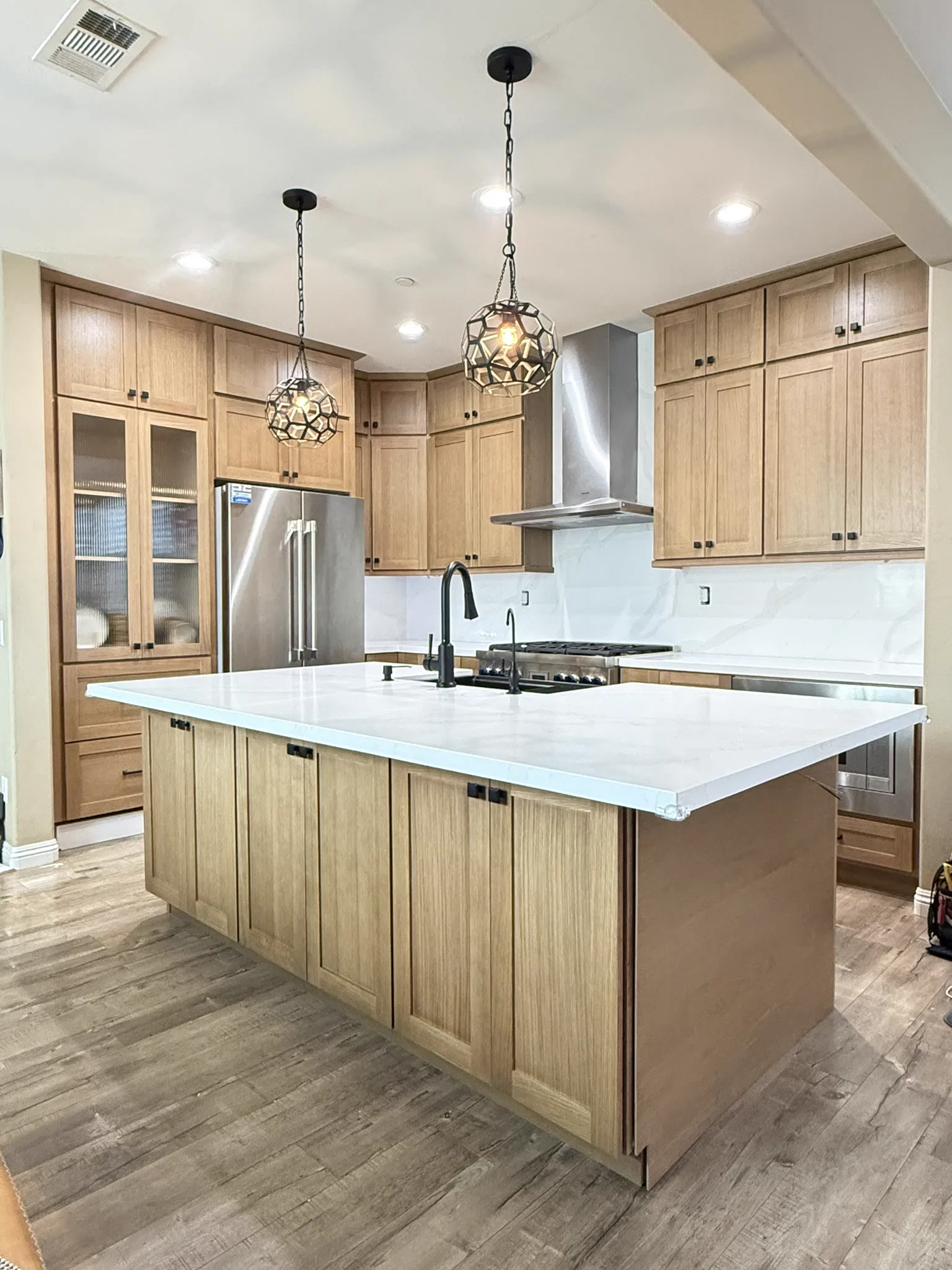
This decision gets made in a slab yard under bad lighting, usually in a hurry, and then you live with it for twenty years. It is worth ten minutes of thinking beforehand.
The practical difference
Granite is quarried stone. Every slab is unique, it is porous, and it needs to be sealed.
Quartz is engineered: ground natural quartz bound with resin. It is non porous, the pattern is consistent slab to slab, and it never needs sealing.
That non porous quality is the single most consequential difference in a kitchen that gets used hard. Red wine, olive oil, turmeric, and beet juice are the usual culprits, and on unsealed or under sealed granite they can leave a mark.
Where each one wins
Quartz is the better choice when
- There are kids in the house, or anyone who cooks without thinking about the counter
- You want a consistent look across a long run or a large island
- You do not want to think about maintenance ever again
- You want a solid white or a very uniform pattern, which is difficult to find in natural stone
Granite is the better choice when
- You want a pattern no other kitchen has
- You set hot pans down directly, out of habit you will not break
- The counter gets direct sun for hours a day
- You prefer natural stone and do not mind sealing it
Quartz resists stains better. Granite resists heat better. Almost every other comparison you will read is a variation of those two facts.
Heat and sunlight, the two real limits of quartz
The resin that makes quartz non porous is also what makes it vulnerable. A pan straight off the burner can scorch or discolor it, and the damage does not come out. Use a trivet. If you know you will not, buy granite.
Prolonged direct sunlight can also fade some quartz over years. For a counter under a large south or west facing window, or for an outdoor kitchen, granite is the safer specification.
Things nobody mentions until installation day
Seams
Any run longer than a slab will have a seam. Where it falls is a choice, and a good fabricator will place it where it is least visible. Ask where yours will be before the template is cut, not after.
Edge profile
The edge changes how the whole kitchen reads more than people expect. A simple eased or square edge looks current. Heavy ornate profiles date a kitchen quickly.
Template, then fabrication
Counters are templated after cabinets are installed, then fabricated, then set. That is typically one to two weeks during which you have cabinets and no counter. It is normal, and it is worth knowing in advance.
If you want the short answer
For most family kitchens in the Inland Empire, quartz is the lower regret choice: no sealing, no stains, consistent appearance. Choose granite if you want a one of a kind slab, if the counter takes direct sun, or if you genuinely will not use a trivet.
Thinking about a project like this?
We are a family-owned general contractor in Fontana, serving the Inland Empire for over twenty years. Free estimates, and no charge for the visit.
Call (909) 232-4669CSLB #1087664, Class B · Bonded and insured · BBB A+ rated · Se habla español